
















The modern skincare aisle is a labyrinth of scientific jargon and bold marketing claims. A product promising “clinical-grade rejuvenation” or “natural detoxification” can be compelling, but the true story of its efficacy and safety lies not on the front of the bottle, but in the tiny, dense print on the back—the ingredient list. For the average consumer, this list can be intimidating and incomprehensible. However, learning to decode it is the single most powerful skill you can develop for your skin health. It empowers you to move beyond hype, avoid potential irritants, and select products filled with evidence-backed ingredients that truly benefit your unique skin. This guide will demystify the language of cosmetic chemistry, providing a clear framework for distinguishing between ingredients to be cautious of and those to actively embrace.
1. The Red Flag Ingredients: Understanding What to Be Cautious Of
While the dose makes the poison, and many ingredients are safe in regulated concentrations, some are known to be problematic for certain skin types or are best avoided with consistent, long-term use.
Potentially Harsh Surfactants:
- Sodium Lauryl Sulfate (SLS): A powerful detergent that creates a rich lather. It is excellent for cleaning greasy surfaces but can be too effective at stripping the skin’s natural oils, leading to a compromised skin barrier, dryness, and irritation, especially for those with sensitive, dry, or eczema-prone skin.
- What to Look For: Often found in foaming cleansers, body washes, and shampoos. If your skin feels “squeaky clean” and tight after washing, SLS is likely the culprit.
High-Risk Preservatives:
- Formaldehyde and Formaldehyde-Releasers (e.g., DMDM Hydantoin, Imidazolidinyl Urea): Used to prevent microbial growth in products. Formaldehyde is a known allergen and carcinogen. While the amounts in cosmetics are low, they can cause allergic contact dermatitis in sensitive individuals.
- What to Look For: More common in lotions, shampoos, and other water-based products that sit in a shower, a warm, moist environment.
Comedogenic (Pore-Clogging) Oils:
- Examples: Coconut Oil (highly comedogenic), Cocoa Butter, Wheat Germ Oil.
- The Nuance: These are not “bad” ingredients. They can be wonderfully moisturizing for the body or for very dry, non-acne-prone facial skin. However, for those with oily or acne-prone skin, these heavy oils can easily clog pores and lead to breakouts.
- What to Look For: If you are prone to blackheads and whiteheads, check the ingredient list of your heavy creams and balms.
Sensitizing Fragrances:
- “Fragrance” or “Parfum”: This is a protected trade secret term that can hide dozens to hundreds of individual chemical compounds. Many of these are known allergens and sensitizers, meaning they can cause irritation or an allergic reaction that develops over time with repeated exposure.
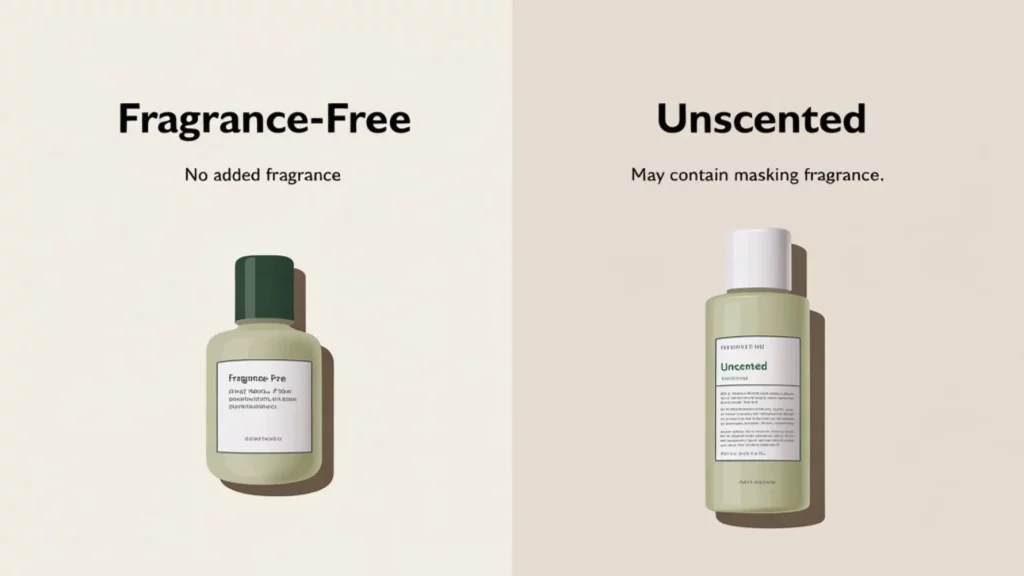
- What to Look For: “Fragrance” on the label. For sensitive skin, seek out products explicitly labeled “Fragrance-Free” (contains no fragrance) rather than “Unscented” (may contain masking fragrances).
2. The Green Light Ingredients: Evidence-Backed Compounds to Embrace
These are the workhorse ingredients with a robust scientific pedigree for delivering tangible results. Spotting them on a label is a sign of a well-formulated product.
Proven Hydrators:
- Hyaluronic Acid & Sodium Hyaluronate: A powerful humectant that can hold up to 1,000 times its weight in water. It draws moisture into the skin, providing immediate plumping and hydration. Different molecular weights allow it to work on the surface and in deeper layers.
- Glycerin: A classic, reliable, and inexpensive humectant that is excellent at helping the skin maintain hydration. It’s a hallmark of effective, no-frills moisturizers.
Cellular Communicators and Barrier Repair Agents:
- Niacinamide (Vitamin B3): A true multi-tasker. It helps improve the skin barrier, reduce redness and blotchiness, minimize the appearance of pores, and regulate oil production. It is well-tolerated by almost all skin types.
- Ceramides: These are lipids (fats) that make up about 50% of the skin’s barrier. Topical application in creams and serums helps to replenish the skin’s natural defense system, reducing water loss and protecting against environmental aggressors. Essential for those with dry or compromised skin.
Gentle Exfoliants:
- AHAs (Glycolic Acid, Lactic Acid, Mandelic Acid): Water-soluble acids that work on the skin’s surface to dissolve the “glue” that holds dead skin cells together. They promote cell turnover, improving texture, brightness, and fine lines.
- BHA (Salicylic Acid): An oil-soluble acid (beta-hydroxy acid) that can penetrate into pores to dissolve the mix of sebum and dead skin that leads to clogs and blackheads. The gold standard for treating and preventing acne.
Antioxidants:
- Vitamin C (L-Ascorbic Acid): The most researched antioxidant for skin. It neutralizes free radicals from UV exposure and pollution, helps to fade hyperpigmentation, and is a critical co-factor for collagen synthesis.
- Vitamin E (Tocopherol): Often paired with Vitamin C to enhance its stability and efficacy. It protects the lipid-rich cell membranes from oxidative damage.
3. The Hierarchy of Information: How to Read the “Small Print” Correctly
The structure of an ingredient list is governed by regulations, not random chance. Understanding its rules is key to accurate interpretation.
The Concentration Rule:
Ingredients are listed in descending order of concentration. The first five ingredients typically make up the bulk of the product.
- Example: If “Water” is first and “Aloe Barbadensis Leaf Juice” is last, the product contains more water than aloe vera. An active ingredient listed at the very end is likely present in a minuscule, potentially ineffective amount.
The “1% Rule”:
Any ingredient present at a concentration of 1% or less can be listed in any order after the ingredients above 1%. This is important because certain mandatory ingredients fall into this category.
- Key Thresholds: Preservatives, fragrances, and certain active ingredients like peptides and most acids are often used at concentrations below 1%. If you see Tetrasodium EDTA (a common chelating agent) or a preservative like Phenoxyethanol, everything listed after it is at 1% or less.
Botanical Names:
Don’t be intimidated by Latin. “Lavandula Angustifolia (Lavender) Oil” is simply the International Nomenclature of Cosmetic Ingredients (INCI) name for lavender oil. It’s a standardized system for clarity, not an attempt to confuse you.
4. Seeing Through the Hype: Identifying and Ignoring Misleading Claims
Marketing language is designed to sell, not to inform. Learning to see past it will save you money and disappointment.
“Hypoallergenic”:
This term has no legal or standardized definition. A company can put it on any product without having to prove it is less likely to cause allergic reactions. Relying on the ingredient list is a more reliable method for avoiding allergens.
“Dermatologist Tested”:
This only means a dermatologist was involved in testing the product at some point. It does not mean the dermatologist endorsed it, that it was tested on a large group, or that it is suitable for all skin types.
“Clinical Results” or “Proven to Reduce Wrinkles”:
Look for the asterisk (*) and read the fine print. The claim is often based on a study conducted under specific, controlled conditions that may not reflect real-world use. The results might be statistically significant but visually minimal.
“Natural” and “Organic”:
- “Natural” is unregulated in cosmetics. A product containing 1% plant extract and 99% synthetic chemicals can be labeled as natural.
- “Organic” has more weight, especially if it carries a certification seal like USDA Organic or COSMOS. This verifies that a certain percentage of the agricultural ingredients are grown organically.
Learning to read an ingredient label is like learning a new language—it takes practice, but the fluency it brings is invaluable. By knowing which ingredients may warrant caution, which are proven performers, how to interpret the list’s hierarchy, and how to disregard marketing fluff, you transform from a passive consumer into an empowered one. You will no longer buy promises; you will buy proven formulations, leading to a smarter, more effective, and safer skincare regimen tailored precisely to your skin’s needs.