




























The quest for a sharp, sculpted jawline is a timeless pursuit in aesthetics, symbolizing youth, strength, and vitality. For generations, achieving this look required the significant commitment of surgical jawline contouring or a full facelift. Today, however, the landscape of facial aesthetics has been revolutionized by a suite of non-surgical procedures that promise to redefine and enhance the jawline without a single incision. From strategically placed injectables to lifting threads, these treatments offer a compelling alternative for those seeking noticeable improvement without the cost, risk, and downtime of surgery. But with multiple options available, who is the ideal candidate? And how do you choose between injectable fillers and PDO threads? This comprehensive guide will dissect the two primary non-surgical approaches, detailing the procedure steps, outlining the inherent risks, and providing a clear-eyed view of the longevity and maintenance required to sustain a beautifully contoured profile.
The Two Pillars of Non-Surgical Contouring: Injectable Fillers vs. PDO Threads
Understanding the fundamental difference between these two technologies is the first step in making an informed decision.
1. Injectable Dermal Fillers: The Art of Addition and Support
- What They Are: Dermal fillers are gel-like substances, most commonly based on Hyaluronic Acid (HA), that are injected beneath the skin to add volume, structure, and support.
- How They Contour the Jawline:
- Building Structure: Fillers are strategically placed along the jawbone itself, from the chin back towards the earlobes. This adds definition and creates a sharper, more prominent mandibular border.
- Supporting Soft Tissue: As we age, skin and fat pads descend, creating jowls. By building a “scaffold” of filler along the jawline, practitioners can provide support to this descending tissue, creating a lifting effect and reducing the appearance of jowls.
- Improving Proportions: Fillers can also be used in the chin to add projection, which in turn enhances the entire jawline’s balance and strength.
- Best For: Individuals with mild to moderate skin laxity, good underlying bone structure that just needs enhancement, and those seeking a subtle, customizable, and reversible result.
2. PDO (Polydioxanone) Threads: The Mechanical Lift
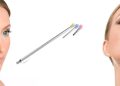
- What They Are: PDO threads are thin, dissolvable sutures made from a material that has been used in cardiac surgery for decades. They are inserted deep into the subcutaneous tissue using a fine needle or cannula.
- How They Contour the Jawline:
- Immediate Mechanical Lift: Barbed or cogged threads have tiny projections that hook onto the sagging soft tissue. When the threads are pulled taut and secured, they physically lift the jowls and skin of the lower face upwards and backwards, providing an immediate, though subtle, lift.
- Biostimulatory Collagen Production: Over time, the PDO material stimulates the body to produce collagen around the thread. This creates a “net” of new supportive tissue that continues to provide lift and skin quality improvement even after the thread itself has dissolved (typically within 6-9 months).
- Best For: Individuals with moderate skin laxity and early jowling who desire a more pronounced lifting effect than fillers can provide alone. It is ideal for addressing the “sag” that filler cannot.
The Procedure Steps: What to Expect in the Treatment Room
While both are minimally invasive, the processes differ.
For Dermal Fillers:
- Consultation & Marking: The practitioner assesses your facial anatomy and marks the precise injection points along your jawline and chin.
- Numbing: A topical numbing cream is applied, and many modern fillers also contain lidocaine for added comfort.
- Injection: Using a needle or cannula, the practitioner deposits the filler in deep, strategic planes along and on top of the jawbone. They will frequently assess symmetry and projection.
- Molding & Assessment: The practitioner may gently massage the area to ensure smoothness. The results are visible immediately. The entire process takes about 30-45 minutes.
For PDO Threads:
- Consultation & Planning: The practitioner determines the vector and anchor points for the lift.
- Local Anesthesia: A local anesthetic is injected to fully numb the treatment area, as the procedure is more involved than filler injections.
- Thread Insertion: Using a needle introducer, the threads are inserted into the subcutaneous layer. The practitioner then gently pulls and adjusts them to achieve the desired lift, before cutting the thread ends so they rest safely under the skin.
- Recovery: There is no “molding” phase. Some swelling and tenderness are common. The procedure takes 45-60 minutes.

Weighing the Risks: A Candid Look at Potential Complications
No procedure is without risk, and informed consent is crucial.
Dermal Filler Risks:
- Bruising and Swelling: The most common side effects, typically resolving within a week.
- Asymmetry: Can occur if the filler is not placed evenly.
- Vascular Compromise: A rare but serious risk if filler is accidentally injected into a blood vessel, which can block blood flow and potentially lead to tissue necrosis (skin death). This is why choosing an expert with profound anatomical knowledge is non-negotiable.
- Lumps or Tyndall Effect: Improper technique can lead to visible lumps or a bluish tint under the skin.
PDO Thread Risks:
- Bruising, Swelling, and Tenderness: More pronounced than with fillers and can last 1-2 weeks.
- Visible or Palpable Threads: In thin-skinned individuals, threads may be faintly visible or felt, especially when smiling. This usually resolves as swelling goes down.
- Thread Migration or Breakage: Though uncommon, a thread can move from its original placement or break, potentially causing dimpling or an irregular contour.
- Infection: As with any procedure that breaks the skin, there is a risk of infection.
Longevity and Maintenance: The Commitment to Your Contour
Both treatments offer temporary results, requiring a long-term plan for maintenance.
Dermal Fillers:
- Longevity: HA fillers in the jawline typically last 12 to 24 months. The dense tissue and minimal movement in the area help the product last longer than in the lips or cheeks.
- Maintenance: To maintain the result, you will need touch-up sessions. The benefit is that the results are customizable and reversible with hyaluronidase if you are unhappy.
PDO Threads:
- Longevity: The immediate lifting effect lasts as long as the thread is physically present, about 6-9 months. However, the collagen-building effect continues, and the overall improvement in skin tightness and contour can last 12-18 months.
- Maintenance: To maintain the lifted appearance, thread treatments are typically repeated annually. Many practitioners combine threads with a small amount of filler to “fine-tune” the result after the initial lift.
Conclusion: A Defined Path to a More Confident You
Non-surgical jawline contouring is a powerful and sophisticated field that can deliver remarkable, natural-looking results for the right candidate. The choice between fillers and threads is not about which is better, but which is better for you.
- Choose fillers if: Your primary goal is to enhance definition, add structure to a weak jawline, and you have minimal sagging. It’s the ideal starting point for a subtle, reversible enhancement.
- Choose threads if: Your main concern is lifting mild to moderate jowls and tightening loose skin. It provides a more structural solution to laxity.
The ultimate key to success lies not in the technology itself, but in the hands of the practitioner. A skilled, board-certified professional will be able to accurately assess your anatomy, recommend the most appropriate treatment (sometimes a combination of both), and perform the procedure with the precision and artistry required to give you a stronger, more defined, and naturally beautiful profile.