


























In the ever-evolving world of aesthetic medicine, two categories of injectables often cause confusion: skin boosters and dermal fillers. While both are administered with fine needles and aim to enhance the appearance, their purposes, mechanisms, and results are fundamentally distinct. Choosing the right treatment is not about which one is “better,” but about which one is correct for your specific concern. Using a filler to address overall skin quality is like using spackle to fix a faded paint job—it addresses the wrong problem. Conversely, using a skin booster to restore lost volume is like applying a high-quality primer to fill a deep hole—it’s insufficient for the task. This guide will dissect the science behind these popular treatments, providing a clear roadmap to help you and your practitioner make the most informed decision for your aesthetic goals.
1. The Inner Glow: What Skin Boosters Actually Do
Skin boosters, also known as bio-remodeling injections or hydrating mesotherapy, are designed to improve the overall quality of the skin. Think of them as intensive, injectable skincare. Their primary target is not volume, but skin health from within.
Mechanism of Action: The “Deep Hydration” Model
The hero ingredient in most skin boosters is non-cross-linked hyaluronic acid (HA). Unlike the HA in fillers, this form is fluid and not designed to provide structural support. It works by:
- Diffusing Throughout the Skin: Once injected into the mid-to-superficial dermis, the fluid HA spreads through the tissue, binding to water molecules like a microscopic sponge.
- Stimulating Endogenous Production: The presence of this high-quality HA acts as a signal to your own fibroblasts (the skin’s collagen-producing cells), encouraging them to become more active. This leads to a gradual increase in the skin’s own production of collagen, elastin, and HA.
- Improving the Skin Microenvironment: By profoundly hydrating the skin tissue and stimulating neocollagenesis, skin boosters work to thicken the dermis, improve elasticity, and enhance radiance.
Ideal Use Cases for Skin Boosters:
- Overall Dehydration: Skin that looks dull, tired, and feels tight, even after moisturizing.
- Fine Lines Associated with Dryness: Especially those that are visible when your face is static, not just when you move it.
- Improving Skin Texture: To address roughness, enlarged pores, and a crepey appearance.
- “Prejuvenation”: For younger patients looking to proactively maintain skin health and delay signs of aging.
Popular products in this category include Profhilo®, Jalupro®, and the Skinboosters range from Teosyal and Restylane.
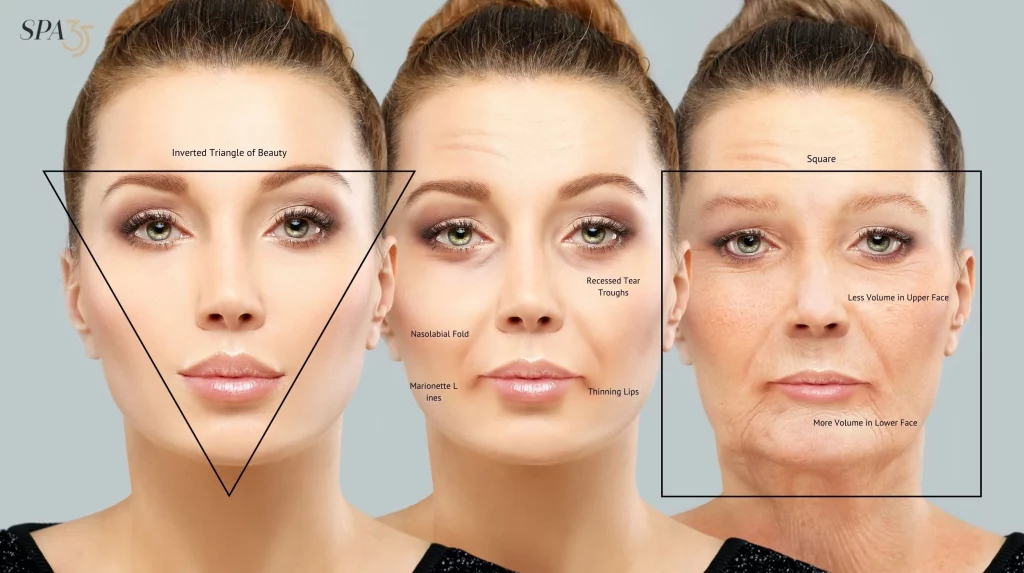
2. The Structural Architect: What Dermal Fillers Actually Do
Dermal fillers are the architects of the aesthetic world. They are designed to sculpt, project, and restore volume. Their primary goal is to alter the shape and contour of the face by physically filling space.
Mechanism of Action: The “Structural Support” Model
Fillers primarily use cross-linked hyaluronic acid. The cross-linking process creates a robust, gel-like substance that is resistant to being broken down too quickly by the body. This gel acts as a temporary implant:
- Providing Immediate Projection: When injected strategically into specific areas, the gel adds physical volume, pushing the skin upward and outward to restore contours.
- Lifting and Supporting: By placing a “pillar” of filler in a key area like the cheeks, a skilled practitioner can lift sagging tissues in the mid-face and jawline, creating a non-surgical lift effect.
- Filling Depressions: They are perfect for filling in static lines (like nasolabial folds) and hollows (like under the eyes or in the temples).
Ideal Use Cases for Dermal Fillers:
- Volume Loss: Restoring cheek volume that has descended with age.
- Facial Contouring: Enhancing the chin, jawline, or balancing facial symmetry.
- Deep Lines and Folds: Filling in pronounced nasolabial folds or marionette lines.
- Lip Enhancement: Adding volume and definition to the lips.
Popular fillers include the Juvéderm®, Restylane®, and Teosyal® families, each with specific formulations for different areas of the face.
3. The Decision Matrix: Choosing the Right Treatment for Your Goal
The choice between a skin booster and a filler boils down to a simple diagnostic question: “Is my primary concern the quality of my skin or the shape of my face?”
| Concern | Recommended Treatment | Why? |
|---|---|---|
| “My skin looks dull and tired.” | Skin Booster | Targets radiance and hydration at a cellular level. |
| “My cheeks have flattened and sunk.” | Dermal Filler | Restores structural volume and projection to the mid-face. |
| “I have fine lines all over my face.” | Skin Booster | Plumps the skin from within, smoothing fine, superficial lines. |
| “The lines from my nose to my mouth are deep.” | Dermal Filler | Physically fills the depression of the fold. |
| “My skin texture is rough and crepey.” | Skin Booster | Improves dermal health and thickness over time. |
| “I want more defined jawline.” | Dermal Filler | Adds structure and contour to the jawline. |
The Synergistic Approach: For many patients, the most comprehensive rejuvenation involves both. A practitioner might recommend a course of skin boosters to globally improve skin quality and hydration, followed by a small amount of filler to strategically restore volume in key areas. This combination addresses both the “canvas” and the “structure” for a supremely natural result.
4. Duration and Experience: Comparing Effects, Durability, and Recovery
Understanding the journey and longevity of each treatment is crucial for setting realistic expectations.
Skin Boosters: The Gradual Glow
- The Process: Requires an initial series of treatments, typically 2-3 sessions spaced one month apart.
- Results: Not immediate. The effects build gradually over 2-3 months as collagen production ramps up. The result is a fresher, more hydrated, and radiant complexion.
- Durability: Once the initial series is complete, results typically last 6-12 months. Maintenance sessions are required 1-2 times per year.
- Recovery/Downtime: Minimal. There may be small pin-prick marks, slight redness, or swelling for a few hours. Makeup can usually be applied immediately after.
Dermal Fillers: The Immediate Impact
- The Process: A single treatment session.
- Results: Immediate. You walk out of the clinic with the restored volume and contour. Note: There can be initial swelling that makes the result look more pronounced for the first few days.
- Durability: Varies by product and area, but typically lasts from 9 months (for lips) up to 18-24 months (for cheeks).
- Recovery/Downtime: Moderate. Expect swelling, tenderness, and potential bruising for 3-7 days. Bruising can be covered with makeup after 24 hours.
5. Safety and Side Effects: What to Expect
Both treatments are generally safe when administered by a qualified medical professional, but they carry different risk profiles.
Skin Boosters:
- Common Side Effects: Temporary redness, swelling, and tiny bumps at the injection sites that usually resolve within hours.
- Rare Risks: As with any injection, there is a minimal risk of infection or allergy. Because the product is fluid and superficial, the risk of vascular complications is extremely low.
Dermal Fillers:
- Common Side Effects: Swelling, bruising, tenderness, and asymmetry (often due to swelling).
- More Significant Risks: Because filler is a gel injected more deeply, there is a small but serious risk of vascular occlusion, where filler is inadvertently injected into a blood vessel, potentially blocking it and compromising the blood supply to the skin. This is a medical emergency that requires immediate treatment with hyaluronidase (an enzyme that dissolves HA filler). This underscores the critical importance of choosing an expert injector with a deep knowledge of facial anatomy.
The worlds of skin boosters and fillers, while both using hyaluronic acid, are separate and distinct. Skin boosters are an investment in your skin’s long-term health and luminosity, working from the inside out. Dermal fillers are a tool for architectural restoration, expertly reshaping and volumizing the face. By understanding their unique roles—and recognizing that they are often powerful allies rather than competitors—you can embark on your aesthetic journey with clarity, confidence, and the knowledge to achieve the specific results you desire.